
EOT Scheme (Employee Ownership Trust)

EOT Scheme (Employee Ownership Trust)
- The EOT scheme lets a qualifying trust acquire a controlling stake (≥51%) for the long-term benefit of employees
- Success hinges on a fair, defensible valuation, a sustainable funding plan, and independent trustee governance
- We assess fit and eligibility, design the structure, and help you deliver an EOT with minimal disruption
What is the EOT scheme?
The UK Employee Ownership Trust (EOT) scheme is a route for owners to sell a controlling interest in their company to a trust that holds shares for employees’ benefit. Founders typically receive consideration over time via an agreed funding mix (e.g., vendor loan + bank debt). The business continues under its own brand and leadership, with employees benefiting via a structured profit-share policy.
We’ve structured 87+ of these deals. Most qualifying sellers now pay an effective 12% CGT — the relief was halved in the last Budget, and it still beats every other route on tax.

Who the EOT scheme suits
Good fit for
- Founders prioritising legacy, culture and independence
- Stable cash flows that can service funding without starving growth
- A leadership team ready to run the company post-transaction
- A workforce you want to retain and engage long-term
Think twice if
- Earnings are volatile and near-term cash is tight
- Leadership capacity or succession is unclear
- There’s no credible valuation rationale or funding headroom

Eligibility & key criteria
Benefits commonly sought
- Control: the trust usually acquires ≥51% of ordinary share capital and voting rights
- All-employee benefit: the trust benefits employees on a broadly similar basis
- Trading requirement: the company must be a trading company or group
- Independence & governance: trustee arrangements must be genuine and independent
- Fair value: price must be reasonable based on independent valuation
(We’ll confirm how these apply to your situation and coordinate with your tax/legal advisers.)
The fine print, in plain English: the EOT qualifying rules.
“Exit Better’s knowledge of EOTs was clear from the start.” — Joel Cohen, Emporium Eyewear
How an EOT is implemented
1. Discovery & objectives
clarify founder goals (price, timing, legacy)2.Fit & valuation drivers
quality of earnings, risks, growth outlook3. Structure & funding
ownership diagram, trustee model, vendor/bank mix4. Governance & comms
trustee remit, board cadence, employee narrative5. Documentation & completion
advisers finalise legal/tax; execute the transaction6. Aftercare
embed policies, performance routines and trustee training
Service modules
- Trustee & board effectiveness – role clarity, training, meeting packs, annual cycle
- Policy library – profit-share, conflicts, related-party, whistleblowing, comms cadence
- Leadership & succession – decision rights, delegation guardrails, succession maps
- Employee engagement – council setup, surveys, recognition, EO education pathway
- Performance & data – KPI tree, dashboard, review rhythm, continuous improvement
- Financial resilience – cash-flow, refinancing options, covenant checks, “what-ifs”
- EO compliance – tidy documentation, annual confirmations, governance audit trail
What “good” looks like in an employee-owned firm
- Employees know how ownership works and see the link between effort and reward
- Trustee is independent and confident, with a clear view of success and risk
- Meetings are short, prepared and decisive; actions are tracked to done
- Profit-share is predictable and fair, anchored to sustainable performance
- Dashboards are clear and reviewed monthly; surprises are rare
- Culture feels open, purposeful and steady—even during growth or change
Deliverables you’ll receive
- Health-check report + 90-day plan
- Governance map, meeting cadence and pack templates
- Profit-share policy draft + employee comms kit
- KPI tree, dashboard and “monthly review” playbook
- Trustee training deck and reference pack
- Risk & compliance checklist with annual cycle
Indicative timelines & fees
1. Health-check + 90-day plan
~3–4 weeks2. Implementation
Typically 8–12 weeks for the full tune-up3. Fees
Fixed-fee strategy phase; execution on retainer/project basis with transparent scope
FAQs
We did the EOT—why do we still need help?
EO is a structure; performance comes from governance, incentives, clarity and habits. We make the structure work in day-to-day decisions.
Will you replace our accountants or lawyers?
No. We complement them—governance, performance and comms are our lane. We coordinate where finance, tax or legal touch EO policy.
Can profit-share change year to year?
Yes—your policy sets rules tied to sustainable profit and cash. We design it so people understand the “why” and trust the process.
What if the trustee lacks experience?
We train trustees, provide pack templates and set a cadence that builds confidence without adding bureaucracy.
Can you help with refinancing vendor loans?
Yes—cash-flow modelling, options review and lender conversations (with your advisers). The goal: resilience, not strain.
No family successor?
Family business succession compares passing it on, selling out and an EOT when the next generation has other plans.
Take this with you
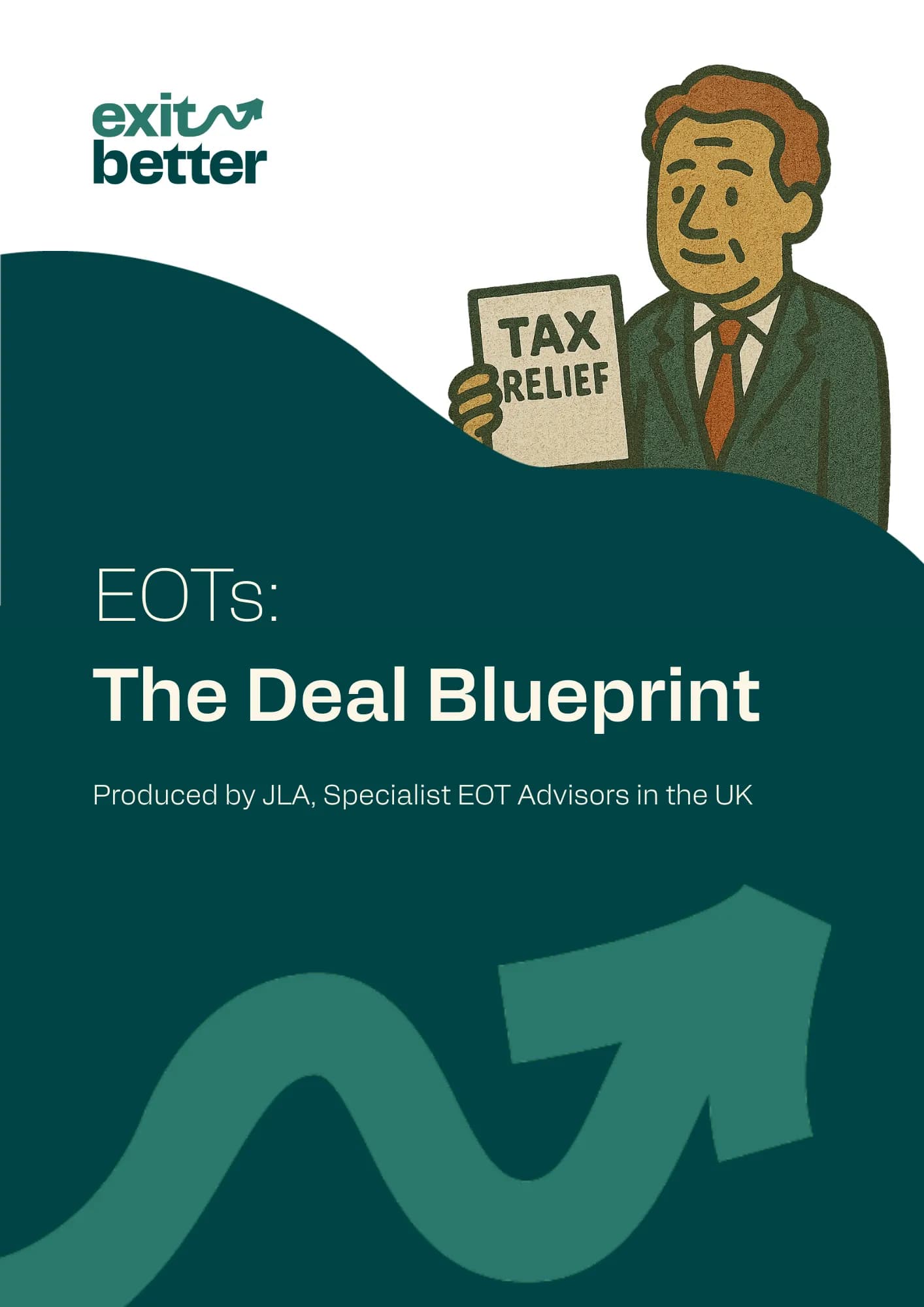
Free guide
EOT: The Deal Blueprint
How the deal is structured, funded and paid. We’ll email it to you.
Updated September 2026 for the post-Budget tax position.
Who this isn’t for
An EOT isn’t for owners who want a lump sum on completion and don’t mind what happens to the staff afterwards — the company pays you over time, and the whole point is that the business carries on. If that’s you, a trade sale may serve you better, and we’ll say so at feasibility.
Want to explore an EOT?
We’ll walk you through the basics. No pressure. No commitments.
- Free call
- Clear advice
- Real numbers
Takes 60 seconds. You’ve got nothing to lose.

Written by Parag Patel | Strategy and Tax Planning Consultant
Parag leads the Exit Better team at JLA Accountants, advising owners on employee ownership, succession and the tax that comes with both.
About the team